Material notes and limits
The page we would want to read before buying leather for a desk. Grades defined, boundaries drawn, and the four things leather will not do stated plainly.
Last updated: 12 August 2026
1 · The food-contact boundary
Coasters, placemats, the table runner and the bottle base are underlays that go between the table and your tableware. The plate, the glass, the bottle or the serving board sits on top of the leather.
They are not food contact materials. Food should not rest directly on the leather, and we make no food-grade claim for any piece on this site. Leather is not manufactured or certified for direct food contact under Regulation (EC) 1935/2004, and we will not imply otherwise to make a sale.
Pieces this applies to:
- Coaster Set of 4, Round
- Coaster Set of 4, Square
- Coaster Set of 6 with Holder
- Placemat 45 × 33, Pair
- Placemat Set of 4
- Table Runner 120 × 30
- Bottle Coaster Ø 12
- Desk Starter Set
- The Dressed Desk
2 · Heat and moisture
Vegetable-tanned leather is water-repellent in the practical sense: a splash beads for long enough to be wiped away. That is the whole of the claim. It is not waterproof, and standing moisture will mark it permanently.
- Keep it under about 40 °C. A warm cup is fine. A pan straight off the hob, a hot plate or a radiator surface is not — heat shrinks and hardens the fibre irreversibly.
- Nothing here is a trivet or a heat mat. Insulation is a safety function and we do not offer it, do not test for it, and do not claim it.
- Wipe spills immediately with a dry cloth and let the piece dry flat, at room temperature, away from any heat source. Never dry leather with a hairdryer or on a radiator.
- Do not soak, machine wash or steam clean any piece, and avoid solvent cleaners, alcohol wipes and disinfectant sprays.
3 · Colour transfer
Deep-dyed leather can transfer colour onto a pale surface when it is warm or damp — a light oak desk, a white lacquered top, a pale stone worktop, an untreated marble. This is characteristic of dyed hide and not a defect.
- Test a small hidden area before laying a new piece on something precious.
- Let a new piece air, unrolled and unloaded, for a few days first.
- The risk is highest with the darkest cognac tones and in humid rooms.
4 · Cutting tolerance
Every outer dimension on this site carries a tolerance of ±3 mm. Pieces are cut by hand from hides that are themselves not perfectly flat. If you are working to a millimetre — an inset panel, a drawer base — build that tolerance into your measurement or ask for a bespoke cut and tell us the constraint.
5 · Which leather is which
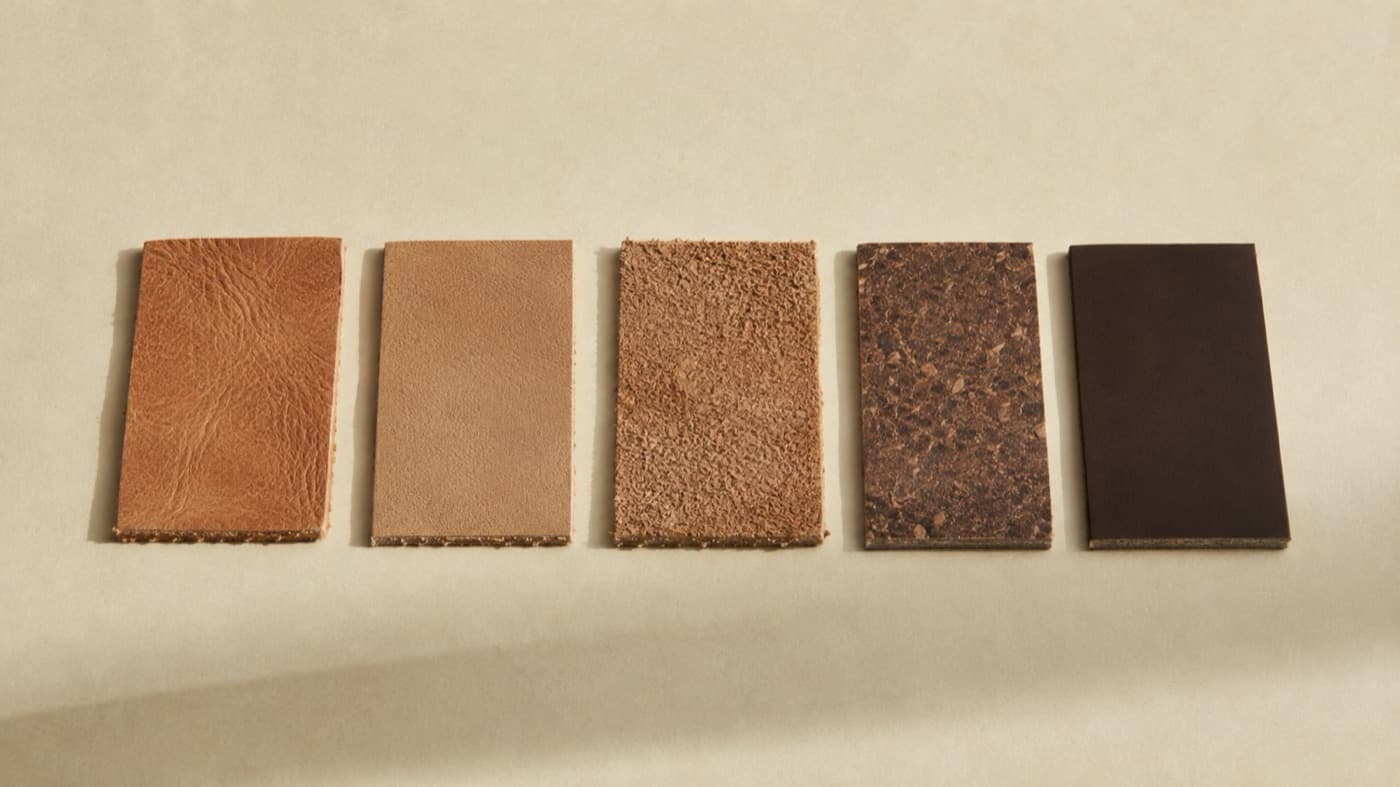
These four words mean four different things, and we use each of them literally. No item on this site is described as full-grain unless it is.
| Term | What it actually is |
|---|---|
| Vollnarbenleder — full-grain | The outermost layer of the hide with its grain intact and unsanded. The strongest and most durable layer; it develops a patina. Most of this catalogue. |
| Rindsleder — top-grain | Hide whose surface has been lightly corrected and finished for evenness. Still hide, still durable, less character than full-grain. |
| Spaltleder — split | The fibrous layer beneath the grain, i.e. suede. Softer, weaker, marks easily. Used here for linings and drawer liners, and named as split wherever it appears. |
| Lederfaserstoff — reconstituted leather fibre | Leather fibre ground from tannery offcuts and bonded into a sheet with latex and natural binders. A different material from hide. It is never called simply "leather" on this site, and its fibre content is always stated. |
| Kunstleder — synthetic | PU or PVC on a textile backing. Not sold here at all — we mention it only so the comparison is complete. |
6 · Tanning and chemicals
Most of the catalogue is vegetable-tanned — tanned with plant extracts, slower, and the reason the material darkens with light and use. 3 pieces are chrome-tanned, chosen where suppleness in a cold or damp place matters more than patina; each says so on its own page.
- Materials are sourced against REACH Annex XVII, including the chromium VI limit of 3 mg/kg and the azo dye restrictions.
- Supplier declarations are held on file [documentation to be attached before trading].
7 · Animal origin
Cattle hide only, a by-product of the food industry. We do not sell fur, and we do not sell leather from any species listed under CITES — not on request and not as a special order.
8 · Sensitive skin
Tanning agents and dyes can cause contact allergy in individual cases. We do not claim that any piece is hypoallergenic or allergen-free. If you know you react to chromium, choose a vegetable-tanned piece and read the tanning line on the product page.
9 · Nothing electrical
No item on this site carries current, generates heat, charges anything or contains electronic components. The cable pieces are straps and a lift-off sleeve — passive leather, no insulation function, no CE marking obligation under the EMC or Low Voltage Directives.
10 · Care
Dust dry. Wipe spills at once and dry flat away from heat. A colourless balm once or twice a year on smooth hide; nothing on suede or split leather but a soft brush. Full guidance on the care and patina page.
Questions about this page? Write to support@jahnlederwaren.shop or call +49 1601984639. Governing law: Federal Republic of Germany.